
Workshop Dates: 1st & 2nd August 2025
Organized by: RF & Communication Domain, Department of Electronics and Communication Engineering
In Association with: IETE Student Forum (ISF)
Resource Person: Mr. P. Bhargava
Assistant Professor, Vasavi Engineering College, Hyderabad
Introduction
The Department of Electronics and Communication Engineering (ECE), Vidya Jyothi Institute of Technology (VJIT), in association with the IETE Student Forum (ISF), successfully organized a two-day workshop on “Design and Analysis of Microstrip Antennas using EM Simulation Tools” on 1st and 2nd August 2025.
Microstrip antennas have become one of the most widely used antenna technologies due to their compact size, lightweight structure, low fabrication cost, and extensive applications in modern wireless communication systems. The workshop was designed to provide students with a comprehensive understanding of microstrip antenna fundamentals, design methodologies, and performance analysis using electromagnetic (EM) simulation tools. The program effectively integrated theoretical concepts with practical simulation techniques, enabling participants to gain valuable insights into antenna design and optimization.
Objectives of the Workshop
The workshop was organized with the following objectives:
- To introduce the fundamentals of microstrip antenna theory and electromagnetic wave propagation.
- To familiarize students with the design methodology of microstrip antennas.
- To explain important antenna parameters such as return loss, VSWR, gain, bandwidth, and radiation pattern.
- To provide hands-on exposure to electromagnetic simulation tools for antenna design and analysis.
- To demonstrate practical approaches for optimizing antenna performance for wireless communication applications.
- To encourage students to explore research opportunities in RF and microwave engineering.
Workshop Sessions
The workshop was conducted over two days through expert lectures, demonstrations, and hands-on simulation sessions.
Day 1: Fundamentals of Microstrip Antennas
The first day focused on the theoretical aspects of antenna engineering and the basic principles of microstrip antenna design.
The sessions covered:
- Introduction to electromagnetic waves and antenna fundamentals
- Review of Maxwell’s equations and wave propagation
- Radiation mechanism of microstrip antennas
- Structure and working principle of rectangular microstrip patch antennas
- Design parameters including substrate selection, dielectric constant, patch dimensions, and feeding techniques
- Antenna characteristics such as:
- Radiation Pattern
- Gain
- Directivity
- Bandwidth
- Return Loss (S11)
- VSWR
- Input Impedance
- Polarization
- Applications of microstrip antennas in wireless communication systems
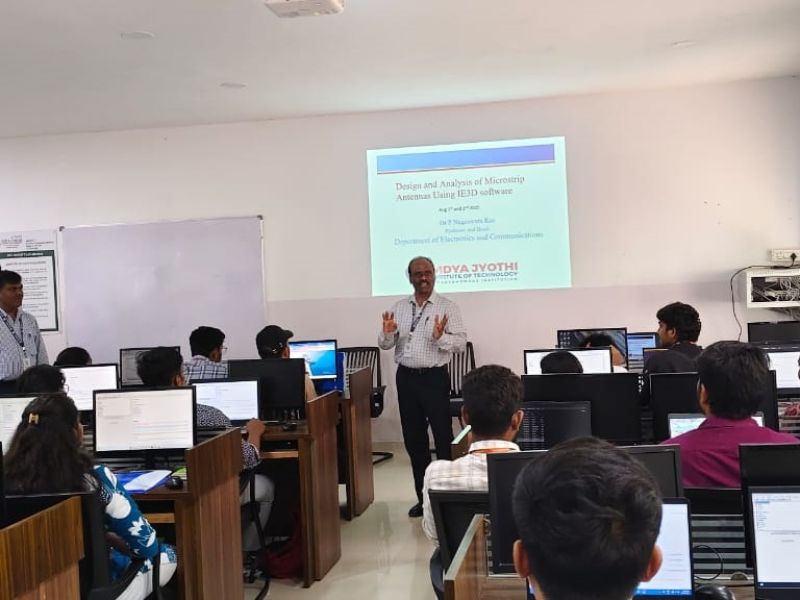
Students actively interacted with the resource person during discussions and gained clarity on the design principles of patch antennas.
Day 2: Design and Analysis using EM Simulation Tools
The second day emphasized practical implementation through electromagnetic simulation software.
The sessions included:
- Introduction to EM simulation environments used in RF and microwave engineering
- Step-by-step design of a rectangular microstrip patch antenna
- Setting simulation parameters and material properties
- Meshing techniques and simulation execution
- Analysis of simulation results including:
- Return Loss (S11)
- VSWR
- Gain
- Radiation Pattern
- Surface Current Distribution
- Electric and Magnetic Field Distribution
- Design optimization techniques for improved antenna performance
- Practical applications of microstrip antennas in:
- Wi-Fi
- Bluetooth
- RFID
- Satellite Communication
- GPS
- Wireless Sensor Networks
- 5G Communication Systems
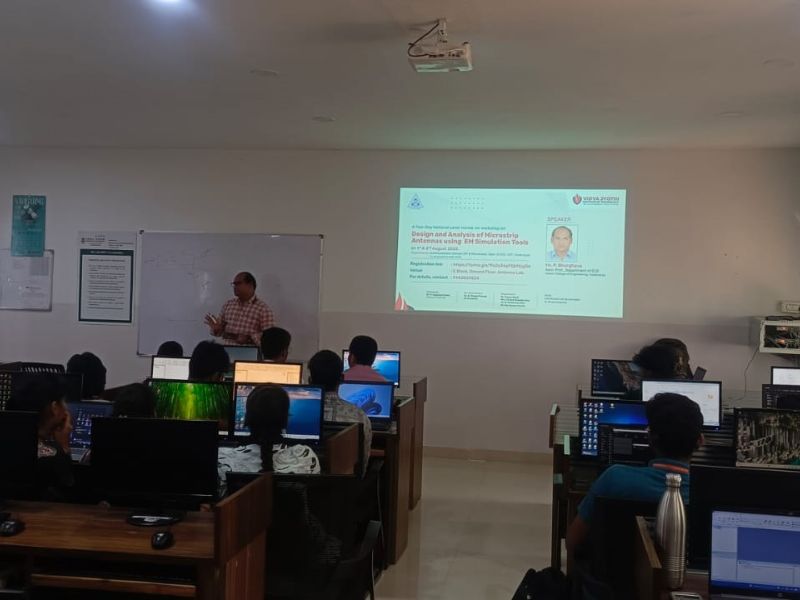
The hands-on sessions enabled students to understand the complete antenna design cycle, from initial modeling to performance evaluation.
Participation
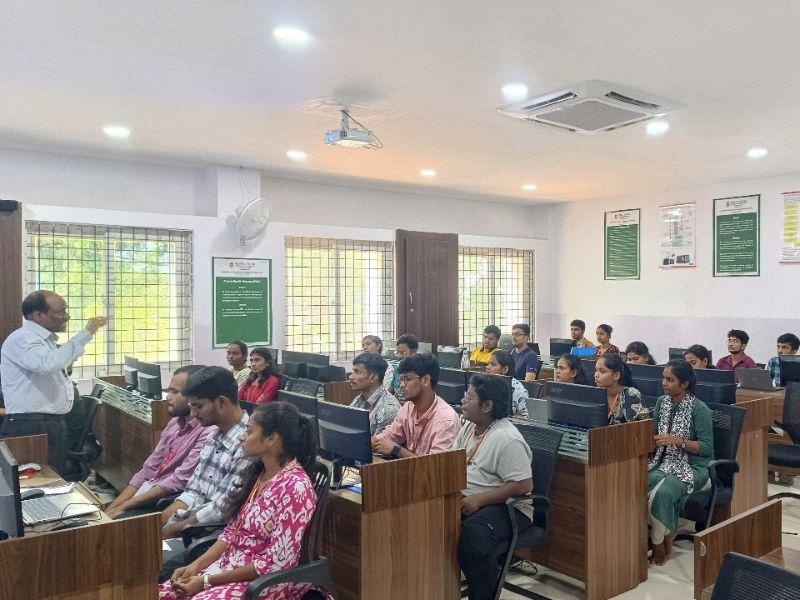
The workshop witnessed enthusiastic participation from 44 students of the Department of Electronics and Communication Engineering. Students actively participated in the interactive sessions, raised insightful questions, and demonstrated great interest during the practical simulation exercises.
Learning Outcomes
By the end of the workshop, participants were able to:
- Understand the fundamentals of electromagnetic wave propagation and microstrip antenna operation.
- Design basic microstrip patch antennas using standard design equations.
- Analyze antenna performance using EM simulation tools.
- Interpret important antenna parameters such as gain, bandwidth, return loss, VSWR, and radiation patterns.
- Understand optimization techniques to improve antenna performance.
- Appreciate the significance of microstrip antennas in modern wireless communication technologies.
Feedback
The workshop received an overwhelmingly positive response from the participants. Students appreciated the systematic presentation of concepts, practical demonstrations, and hands-on simulation sessions conducted by the resource person. The interactive learning environment significantly enhanced their understanding of antenna design and electromagnetic simulation techniques. Many participants expressed their interest in pursuing advanced studies and projects in the RF and Microwave domain.
Conclusion
The two-day workshop on “Design and Analysis of Microstrip Antennas using EM Simulation Tools” successfully achieved its intended objectives by providing participants with a balanced blend of theoretical knowledge and practical exposure. The expert guidance of Mr. P. Bhargava enabled students to gain valuable insights into antenna design methodologies and modern EM simulation techniques.
The Department of Electronics and Communication Engineering sincerely thanks the college management, the RF & Communication Domain, the IETE Student Forum (ISF), and the resource person for their continuous support and valuable contribution in making the workshop a great success. Such technical programs play a significant role in strengthening students’ practical skills and preparing them for careers in wireless communication, RF engineering, and advanced research.








0 Comments