Infrastructure
Infrastructure
Laboratories
Advanced Engineering Physics laboratory, I Year
“Physics isn’t just a theory; it is a Science that is validated by experiments”.
Description: Advanced Engineering Physics lab course is the latent driver for full spectrum of modern technological landscape. This Course takes you out of the lecture hall and brings a sense of anticipation of revolutionary innovation. From the high-speed internet in your pocket to the green energy powering our cities, the experiments paved a gateway to the technologies of all engineering disciplines.
The lab is equipped with state of the art equipment on modern physics experiments exploring quantum mechanics via experiments on Photoelectric Effect, efficiency considerations of semiconductor devices behind digital sensors and energy-efficient displays. The lab course will train the students for Precision measurements at the Micro-Scale for critical engineering applications and spectrum analysis of optical sources using Optical phenomenon like Interference, TIR, Dispersion and Diffraction. The course trains the students to make decisions on design considerations to optimize Solar cells for solving the global energy crisis.
Outcomes of Lab: The student will be able to determine important physical constants such as Planck’s constant and the energy gap of a semiconductor. The student will understand and analyze optical phenomena like interference, diffraction, and dispersion through practical experiments. They will also study and evaluate the electrical and optical characteristics of semiconductor devices such as LEDs, photodiodes, and solar cells. In addition, the student will gain practical knowledge of lasers by determining wavelength using single-slit and diffraction grating methods, and will be able to measure the numerical aperture and bending losses of optical fibers while following proper scientific procedures for data collection and reporting.
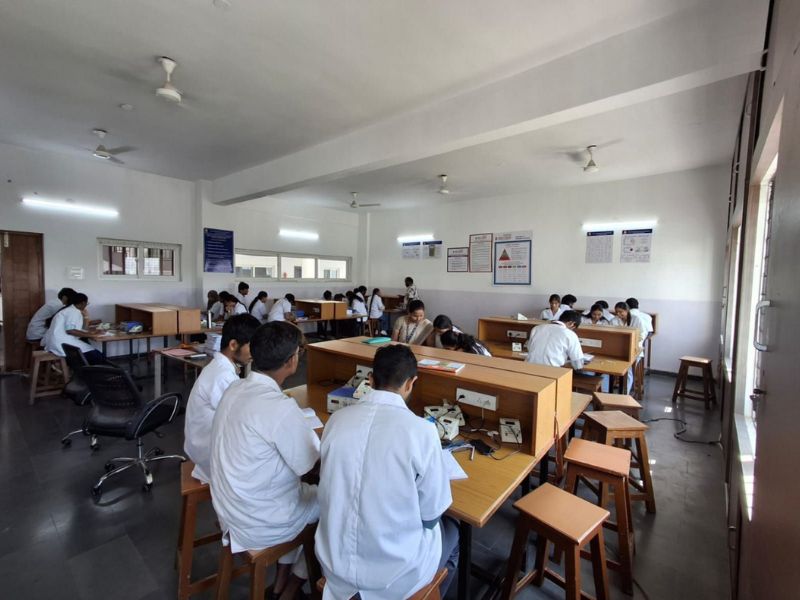
Basic Electrical Engineering Lab, I Year
Description:
The Basic Electrical Engineering Laboratory is designed to provide hands-on experience with fundamental electrical concepts through practical experiments. The lab enables students to verify basic electrical laws and network theorems, analyze DC and AC circuits, study transient behavior of R, L, and C circuits, and understand the performance characteristics of electrical machines and transformers. This laboratory bridges the gap between theoretical knowledge and practical application, helping students develop experimental skills, measurement techniques, and analytical abilities essential for engineering practice.
Outcome of the Lab:
Students will be able to explain the basic principles of electrical elements and laws through experimental verification, apply DC and AC circuit concepts to measure electrical parameters such as voltage, current, power, and impedance, examine the operating principles and performance characteristics of transformers and electrical machines, analyze and compare experimental results with theoretical values, and assess the working principles of alternators and basic electrical installations through hands-on laboratory experiments.
Electrical Circuits Lab, I Year
Description:
The Electrical Circuits Laboratory is intended to provide practical exposure to the fundamental concepts of electrical circuits through experimental verification. The lab focuses on measuring electrical quantities, validating Kirchhoff’s laws and network theorems, studying resonance phenomena, determining circuit parameters, and analyzing AC and DC circuit behavior. It helps students correlate theoretical concepts with real-time experimental observations and develop skills in circuit analysis, instrumentation, and data interpretation.
Outcome of the Lab:
Students will be able to explain basic electrical laws, network theorems, and circuit parameters through experimental setups, perform accurate measurements of voltage, current, resistance, and power in AC and DC circuits using appropriate instruments, analyze experimental results to verify Kirchhoff’s laws, resonance conditions, and network theorems, evaluate circuit performance by
Engineering Chemistry Lab, I Year
Description:
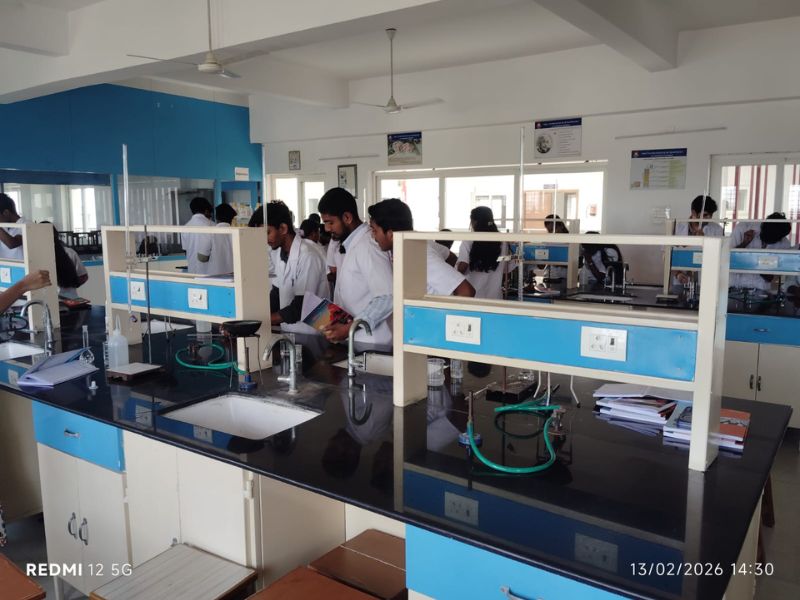
Engineering Chemistry Laboratory is a foundational and practice-oriented course designed to provide students with essential experimental and analytical skills in applied chemistry. The course emphasises the determination of water quality parameters, corrosion behaviour, electrochemical estimations using conductometry and potentiometry, and evaluation of lubricant properties through volumetric and viscometric methods.
With a deliberate focus on hands-on experimentation and analytical interpretation, this laboratory course fosters scientific accuracy, problem-solving ability, and a robust foundation in industrial and engineering chemistry applications.
Outcome of the Lab:
The student will be able to determine water quality parameters and lubricant properties using volumetric and viscometric methods, and understand their significance in industrial applications. They will apply electrochemical techniques such as conductometry and potentiometry to estimate the concentration of acids and analyze chemical reactions. Students will examine the corrosion behavior of metals under different environmental conditions and evaluate the effectiveness of inhibitors in reducing corrosion rates. In addition, they will gain knowledge about the synthesis, properties, and applications of advanced materials such as Thiokol rubber, fuel cells, and smart biomedical materials through both real and virtual laboratory tools. This practical exposure will enhance their analytical skills, experimental techniques, and understanding of the role of chemistry in engineering and industrial applications
Engineering Workshop, I Year
An engineering workshop is a hands-on, practical training environment designed to bridge the gap between theoretical engineering concepts and real-world application. It provides experiential learning through core manufacturing processes—such as fitting, carpentry, welding, machining, and foundry work—to build technical proficiency, safety awareness, and industry-ready skills.
Outcome of the Lab:
Students will be able to understand the tools and methods of using to fabricate engineering Components and applying the methods to read and interpret workshop drawings. Evaluating various methods and trades of workshop in the component building.
IT Workshop, I Year
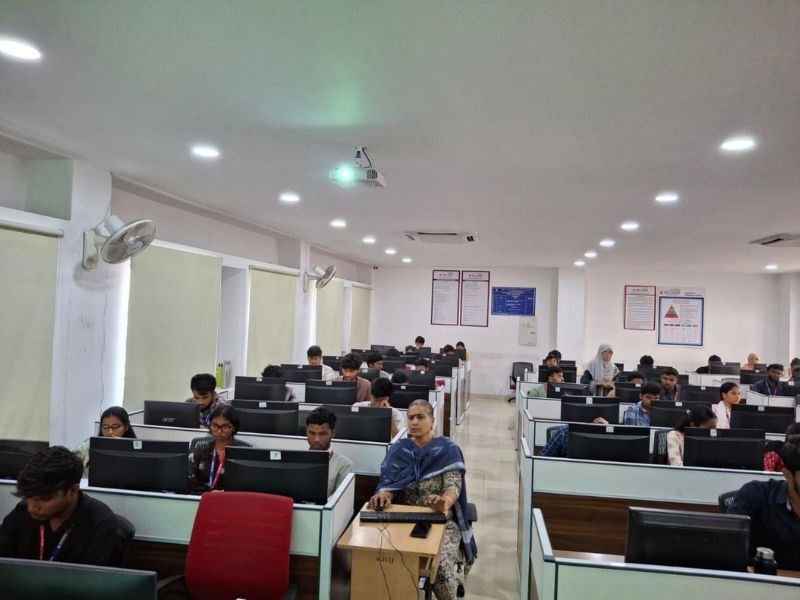
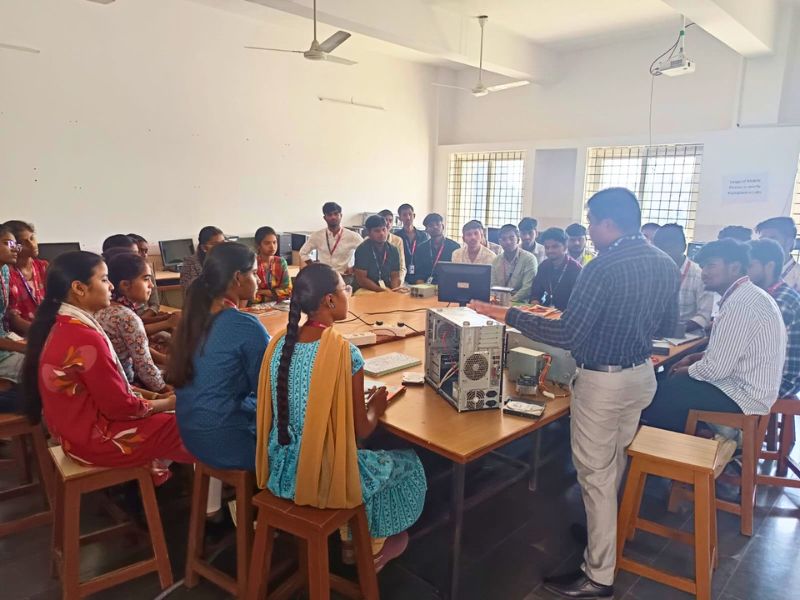
The IT Workshop Lab provides practical training in fundamental computer hardware, software, and productivity tools. Students gain hands-on experience in assembling and disassembling PCs, installing and configuring operating systems such as Windows and Linux, and understanding basic troubleshooting techniques. The lab also develops skills in internet usage, networking basics, and online communication. Training in word processing, spreadsheets, and presentations enables students to create professional documents, analyze data, and deliver effective presentations, thereby strengthening essential technical and digital competencies.
Outcome of the Lab:
Upon successful completion of the IT Workshop Lab, students will be able to assemble and disassemble a personal computer and identify its hardware components. They will install and configure operating systems, including Windows and Linux, and perform basic troubleshooting. Students will demonstrate proficiency in internet usage and networking fundamentals. They will effectively use word processing, spreadsheet, and presentation tools to create professional documents.
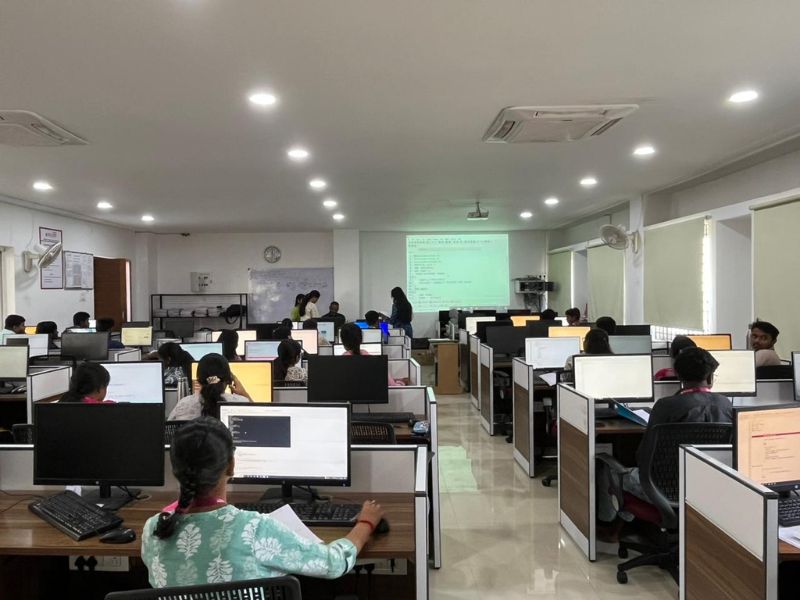
C Programming & Data Structures Lab, I Year
Description:
- Programming Foundations: Introduces the C language, covering syntax, data types, operators, control structures, functions, and file handling.
- Data Structures: Focuses on arrays, linked lists, stacks, queues, trees, and graphs, along with their operations and applications.
- Algorithms: Implementation of searching (linear, binary) and sorting (bubble, quick, merge) algorithms.
- Problem-Solving: Emphasis on designing efficient solutions using appropriate data structures and algorithms.
- Applications: Development of real-time applications to strengthen logical and analytical skills
Outcome of the Lab:
By the end of the lab, students are expected to:
- Practical C Programming Skills
- Write, compile, and debug C programs using loops, conditionals, functions, arrays, pointers, and structures.
- Work with file operations for persistent data storage.
- Data Structure Implementation
- Implement abstract data types (ADTs) such as lists, stacks, and queues using arrays and linked lists.
- Apply tree structures (binary search trees, AVL trees) and graph representations (adjacency lists/matrices).
Algorithmic Thinking
- Analyze and implement sorting and searching algorithms.
- Evaluate efficiency and choose appropriate data structures for problem-solving.
- Problem-Solving & Application Development
- Design small-scale applications (e.g., student record systems, scheduling programs).
- Gain confidence in applying theoretical concepts to real-world problems.
Data Structures Lab, I Year
Description:
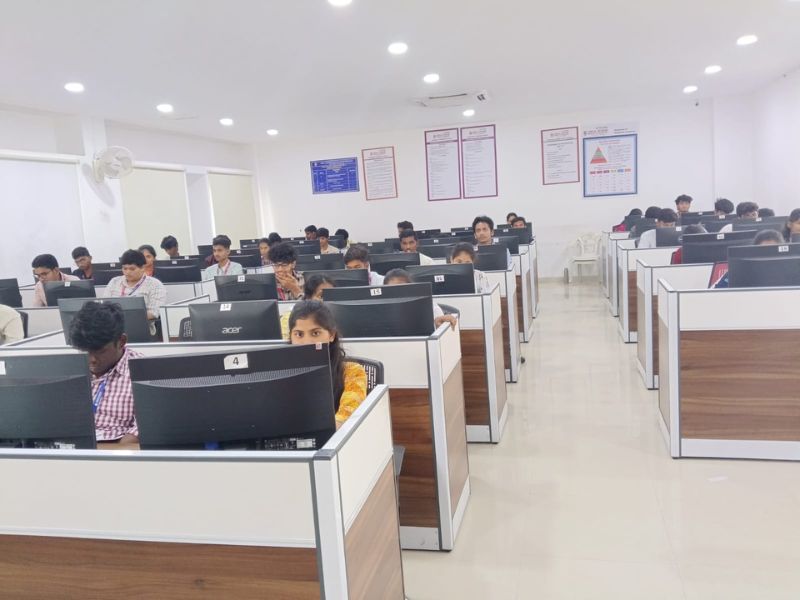
The Data Structures Laboratory is designed to provide practical exposure to the implementation and application of various data structures and algorithms using a programming language such as C or C++. The laboratory focuses on strengthening students’ problem-solving skills by enabling them to design, implement, and analyse efficient data structures for real-world applications.
Students gain hands-on experience in implementing linear and non-linear data structures such as arrays, stacks, queues, linked lists, trees, graphs, and hash tables. The course also emphasizes searching and sorting techniques, recursion, and complexity analysis. Through systematic lab experiments, students learn to evaluate algorithm efficiency using time and space complexity measures.
This laboratory builds a strong foundation for advanced courses such as Design and Analysis of Algorithms, Database Management Systems, Artificial Intelligence, and Machine Learning.
Outcome of the Lab:
Students will gain hands-on experience in writing programs involving trees, graphs, and hashing techniques. They will learn how to implement and apply these data structures to solve real-world problems efficiently. This practical understanding enhances their ability to design optimized solutions and prepares them for advanced topics in computer science and software development
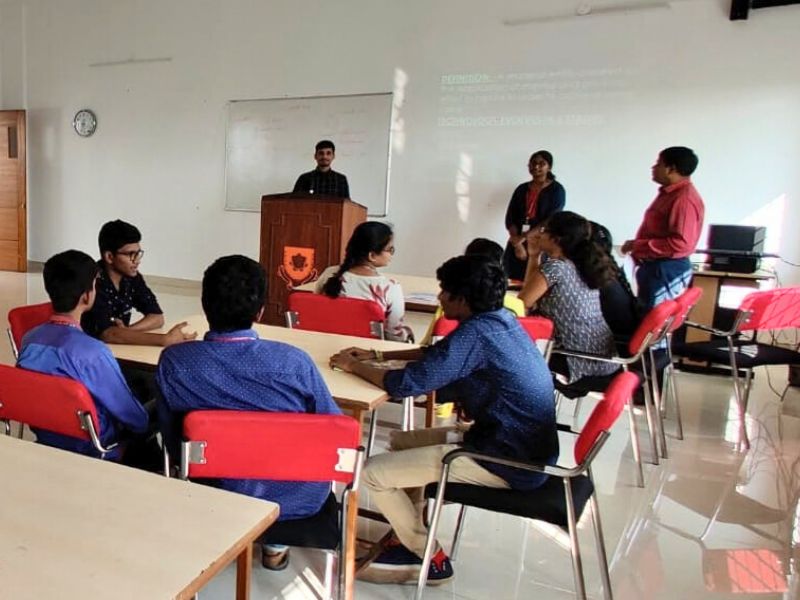
The English Language and Communication Skills (ELCS) Lab, I Year
Description:
ELCS Lab focuses on listening and speaking skills, particularly on the production and practice of sounds of language and familiarizes the students with the use of English in everyday situations both in formal and informal contexts. It enables the students to develop their active listening skills and equip them with necessary training in listening, so that they can comprehend the speech of people from different linguistic backgrounds. It focuses on the improvement of their pronunciation and neutralize accent and express themselves fluently and appropriately in social and professional contexts.
Outcome of the Lab:
The English Language Communication Skills Lab provides a conducive environment and the students’ will be able to develop effective communication skills by strengthening their listening and speaking abilities. It provides a supportive environment where students learn to actively listen, identify key information, and interpret the speaker’s intention. The lab also focuses on improving pronunciation and accent for better intelligibility, enhancing fluency and clarity in speech, and building confidence in communication. Through practical, real-life language activities, students are equipped to use English effectively in academic, professional, and everyday situations.
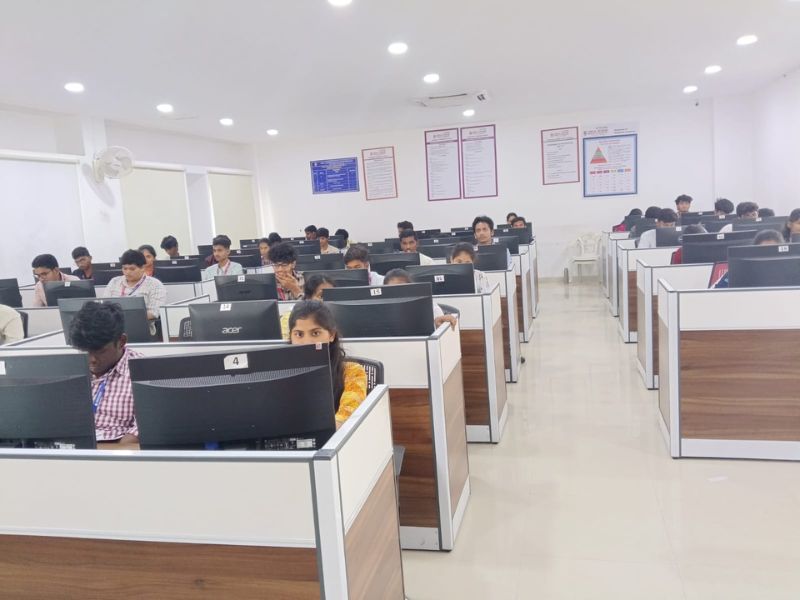
Python Programming Lab-I B.Tech II SEM (CSE,IT,AIML,DS,CE,MECH,EEE)
Description:
The Python Programming Laboratory is designed to provide hands-on experience in developing problem-solving skills using the Python programming language. The course introduces students to fundamental programming concepts and enables them to implement efficient solutions for real-world computational problems.
The laboratory emphasizes writing clear, readable, and modular Python programs using built-in data structures and libraries. Students gain practical knowledge of control structures, functions, strings, lists, tuples, dictionaries, file handling, and basic object-oriented programming concepts. The course also introduces exception handling and basic use of external modules for application development.
Through structured lab exercises, students develop logical thinking, debugging skills, and the ability to design algorithms and translate them into executable Python programs.
Outcome of the Lab:
Students will develop the ability to write and execute programs using Python while strengthening their logical thinking and problem-solving skills. Through hands-on practice, they will become familiar with fundamental programming constructs and learn how to apply them to solve real-world problems. The lab experience also encourages students to write modular and efficient code using structured and object-oriented programming techniques.
Programming for Problem Solving Lab
Description:
The Programming for Problem Solving Laboratory is designed to provide hands-on experience in solving computational problems using programming concepts. The laboratory introduces students to structured programming using the C language and focuses on developing logical thinking, problem-solving ability, and algorithmic skills.
Students learn to design algorithms, develop flowcharts, write C programs, debug errors, and validate outputs. The course emphasizes practical implementation of concepts such as data types, operators, control structures, functions, arrays, strings, pointers, structures, file handling, and basic problem-solving techniques.
Outcome of the Lab:
Students will gain the ability to solve problems using a structured programming approach. They will learn the fundamentals of programming, understand and apply various control statements, effectively use arrays and functions, and implement basic searching and sorting algorithms using the C programming language. This practical exposure strengthens their logical thinking and builds a strong foundation for advanced programming skills.
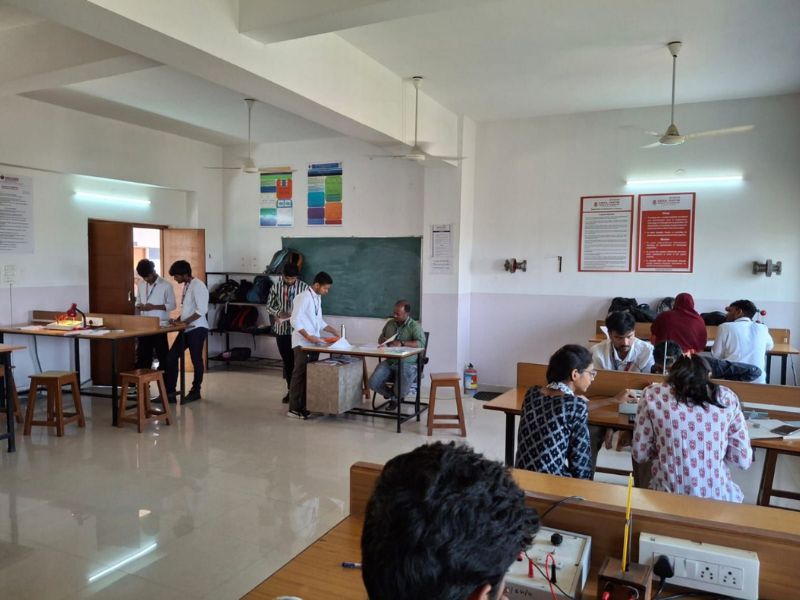
AEP Lab
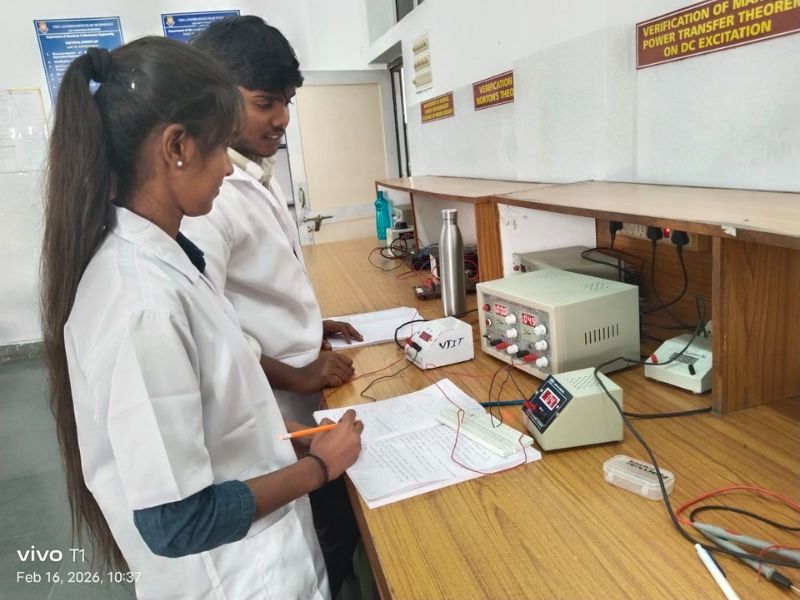
Electrical Circuit Lab
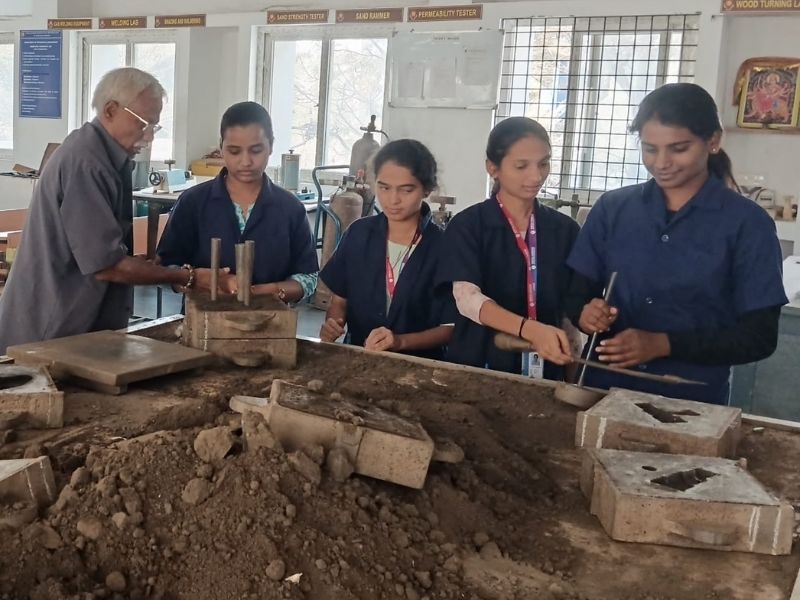
EWS Lab
CPDS Lab
ELCS Lab
Python Programming Lab
BEE Lab
EC Lab
IT Workshop Lab
DS Lab