
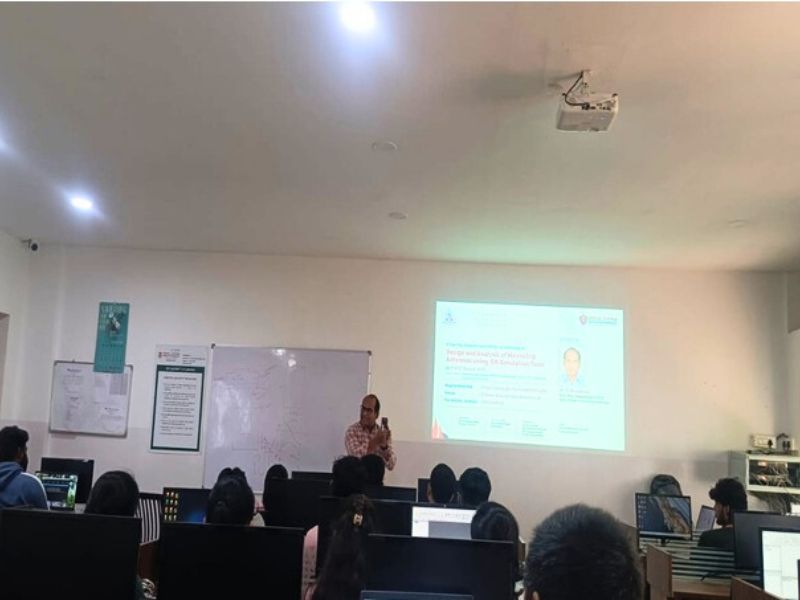
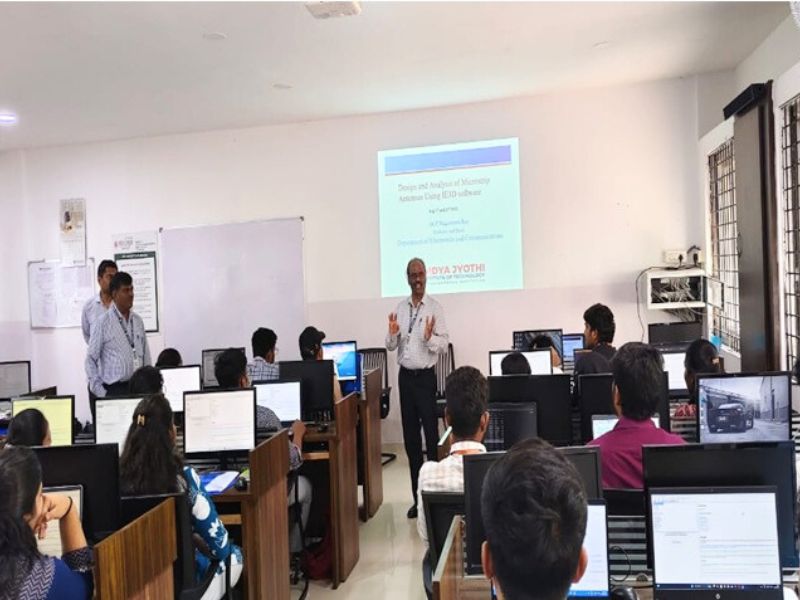
Communication (RF & Microwave)Domain, Department of ECE of Vidya Jyothi Institute of Technology, Hyderabad is organizing a Two day National Level Hands-on Workshop on “Design and Analysis of Microstrip Antennas using EM Simulation Tools” on 1-2nd August 2025 @ E Block, 1stFloor, VLSI Lab. The Day 1 speaker is Dr P NageswaraRao, Professor, Dept. of ECE, Vidya Jyothi Institute of Technology, Hyderabad and Day 2 speaker is Mr. P. Bharghava,Assistant Professor, Department of ECE, Vasavi College of Engineering, Hyderabad.
The field of electronics and communication engineering is rapidly evolving, with antennas playing a pivotal role in nearly every wireless technology, from mobile phones and Wi-Fi to satellite communication and radar systems. Recognizing the fundamental importance of Communication (RF & Microwave) domain, the Department of Electronics and Communication Engineering (ECE) at VidyaJyothi Institute of Technology (VJIT) successfully organized a comprehensive two-day workshop. The workshop aimed to provide students with a strong theoretical foundation and practical insights into the design, characteristics, and applications of various antenna types.
The primary objectives of this workshop were:
- To introduce participants to the fundamental concepts of electromagnetic waves and their propagation.
- To explain the basic principles of antenna theory, including radiation patterns, gain, directivity and impedance matching.
- To familiarize students with different types of antennas and their respective applications.
- To provide hands-on experience (if applicable, specify) with antenna design tools, simulation software, or measurement techniques.
- To foster an understanding of the challenges and advancements in modern antenna technology.
The workshop was structured to cover a wide range of topics over two intensive days, delivered through engaging lectures and interactive sessions. The key topics covered included:
Day 1(01.08.2025): Fundamentals and Basic Antenna Types
Session 1: Introduction to Electromagnetic Waves and Antenna Fundamentals
- Maxwell’s equations and wave propagation.
- Concept of radiated power and antenna efficiency.
- Basic antenna parameters: isotropic radiator, radiation pattern, beamwidth, side lobes, back lobes.
Session 2: Antenna Characteristics and Parameters
- Gain, directivity, effective aperture.
- Input impedance, reflection coefficient, VSWR.
- Polarization: linear, circular, elliptical polarization, Antenna temperature and noise.
Session 3: Types of Antennas – I
- Dipole antennas: half-wave dipole, folded dipole.
- Monopole antennas.
- Loop antennas.
- Arrays: linear arrays, planar arrays, array factor.
Day 2(02.08.2025): Advanced Antennas, Measurement, and Applications
Session 4: Types of Antennas – II
- Patch antennas (microstrip antennas): design considerations, advantages, disadvantages.
- Horn antennas.
- Parabolic reflector antennas.
- Helical antennas.
Session 5: Antenna Measurement and Applications
- Anechoic chambers and outdoor antenna ranges.
- Measurement of radiation pattern, gain, and impedance.
- Applications in wireless communication (cellular, Wi-Fi, Bluetooth), satellite communication, radar, radio astronomy, and RFID.
- Emerging trends in antenna technology (e.g., MIMO, reconfigurable antennas, metamaterial antennas).
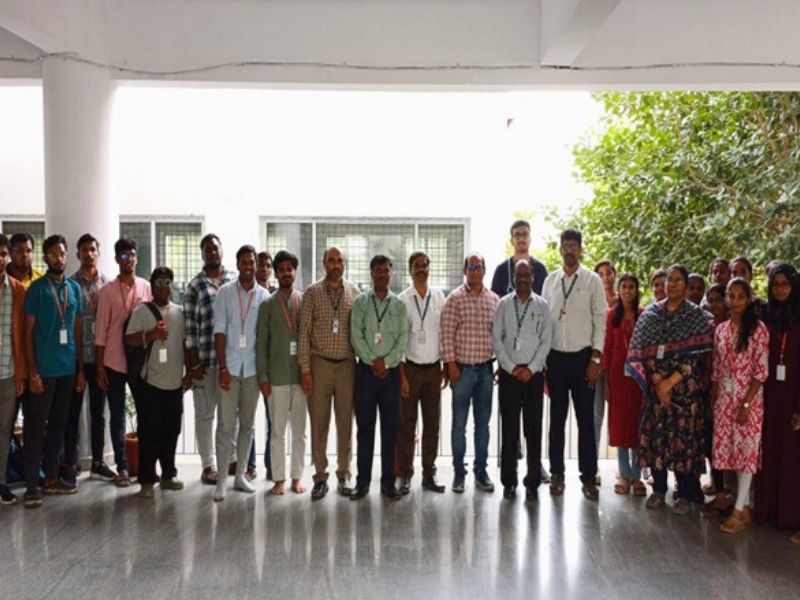
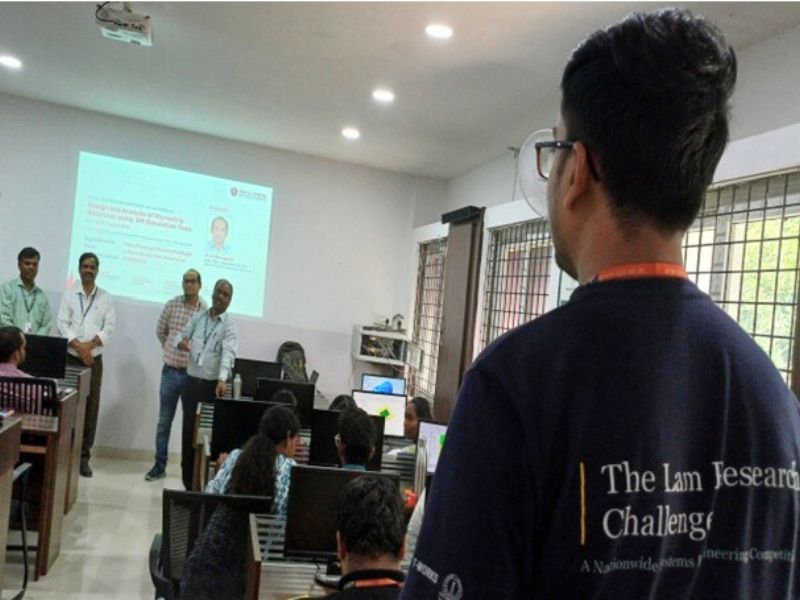
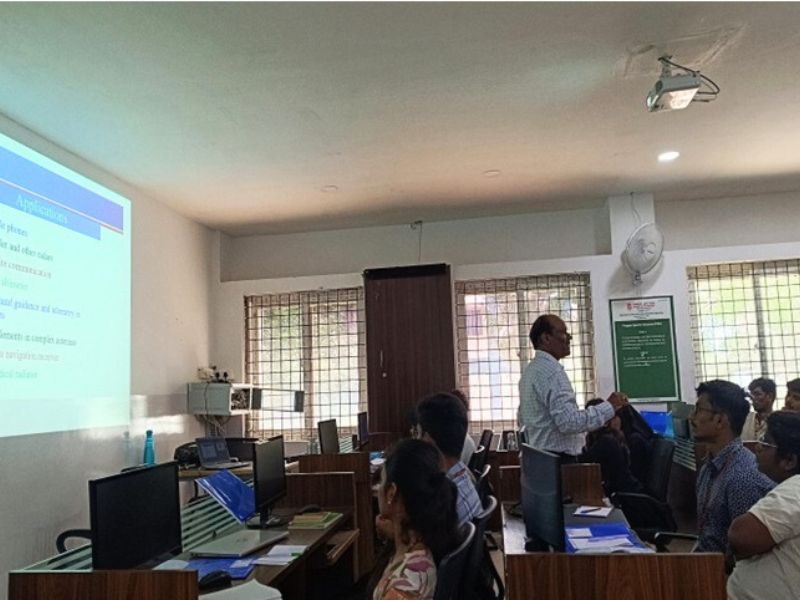
The workshop witnessed enthusiastic participation from 44 students from various semesters of the ECE department, as well as students from other relevant departments. The interactive nature of the sessions encouraged active engagement and insightful discussions throughout both days.
The main Outcomes of workshop is
- The fundamental principles governing antenna operation.
- The characteristics and design considerations for various antenna types.
- The practical applications of antennas in real-world scenarios.
- Hands-on experience with antenna simulation/measurement techniques.
The workshop also served as an excellent platform for students to clarify their doubts, explore advanced topics, and develop a keen interest in the field of antenna design and communication systems.
The feedback received from the participants was overwhelmingly positive. Students highly appreciated the clear explanations, well-structured content, and the opportunity to interact with experienced resource persons. Many expressed that the two-day workshop significantly enhanced their understanding of antenna concepts and their relevance in modern technology.
The Department of ECE, VJIT, extends its gratitude to the college management for their support in organizing this valuable workshop. Such initiatives are crucial in bridging the gap between theoretical knowledge and practical application, thereby preparing students for the challenges and opportunities in the dynamic field of electronics and communication engineering.








0 Comments