
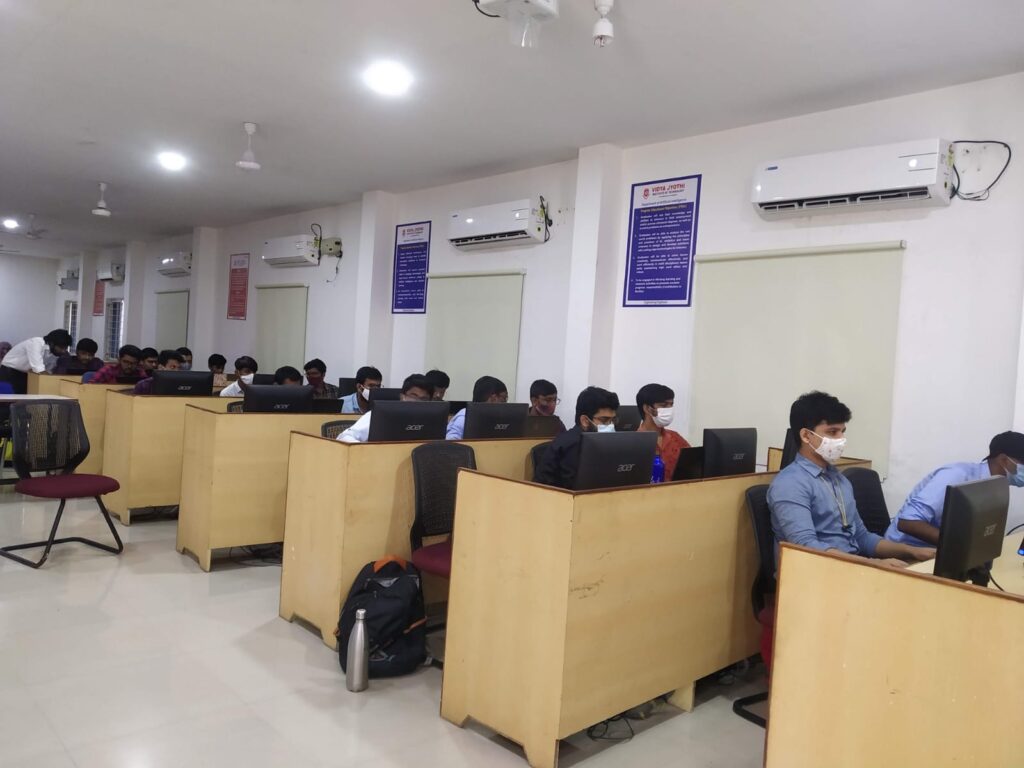
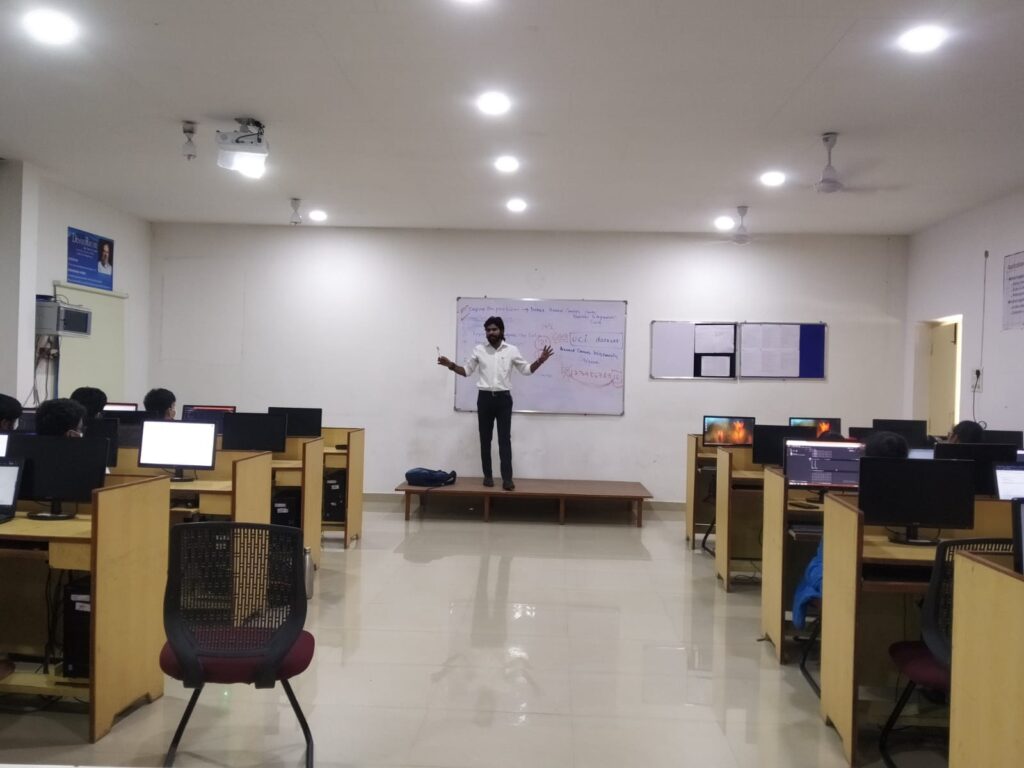
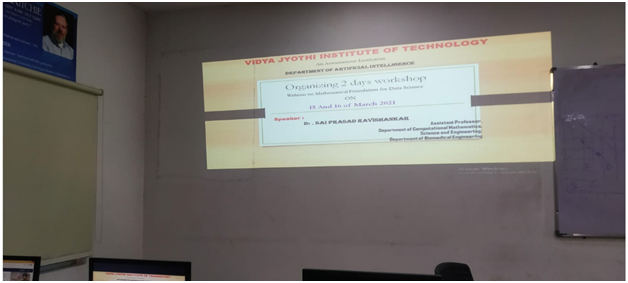
A Two Day Webinar was organized by the department of AI, VJIT on Mathematical Foundation for Data Science on: 15thand 16th of March 2021, Dr. Saiprasad Ravishankar, Assistant Professor, Department of Computational Mathematics Science and Engineering, Department of Biomedical Engineering had given an exemplary presentation on the importance of Mathematical Foundation for Data Science.
He further said that faculty are expected to have a working knowledge of linear algebra and probability. In particular, students should be familiar with basic matrix-vector computations, and have had exposure to the concepts of rank, subspaces, matrix factorization, eigenvalues/eigenvectors, and solving systems of linear equations. They should also be familiar with the concepts of conditional probability, joint density functions, moments (expectation and variance), and Bayes’ rule.
Key Points:
• Formulate statistical inference problems in the language of linear algebra and optimization.
• Analyze and compute the solutions to least-squares problems in the context of regression.
• Become familiar with basic computational methods from optimization.
• Map descriptions of real-world problems into quantitative computational problems.
- Apply appropriate models to solve classical (linear, logistic, Poisson) regression problems
- Implement algorithms for solving unconstrained and constrained optimization problems.
- Identify and understand the differences between different types of convex optimization problems (linear, quadratic, etc).
- Identify and understand the differences between convex and nonconvex optimization problems.
- Describe the computational issues in solving different kinds of statistical inference problems, and how those issues scale with the amount of data available.
- Implement basic machine learning algorithms, including support vector machines and multilayer neural networks.
- Use cross-validation to perform model selection.
- Describe the difference between training error and generalization error, and the effect of sample size on each.








0 Comments